





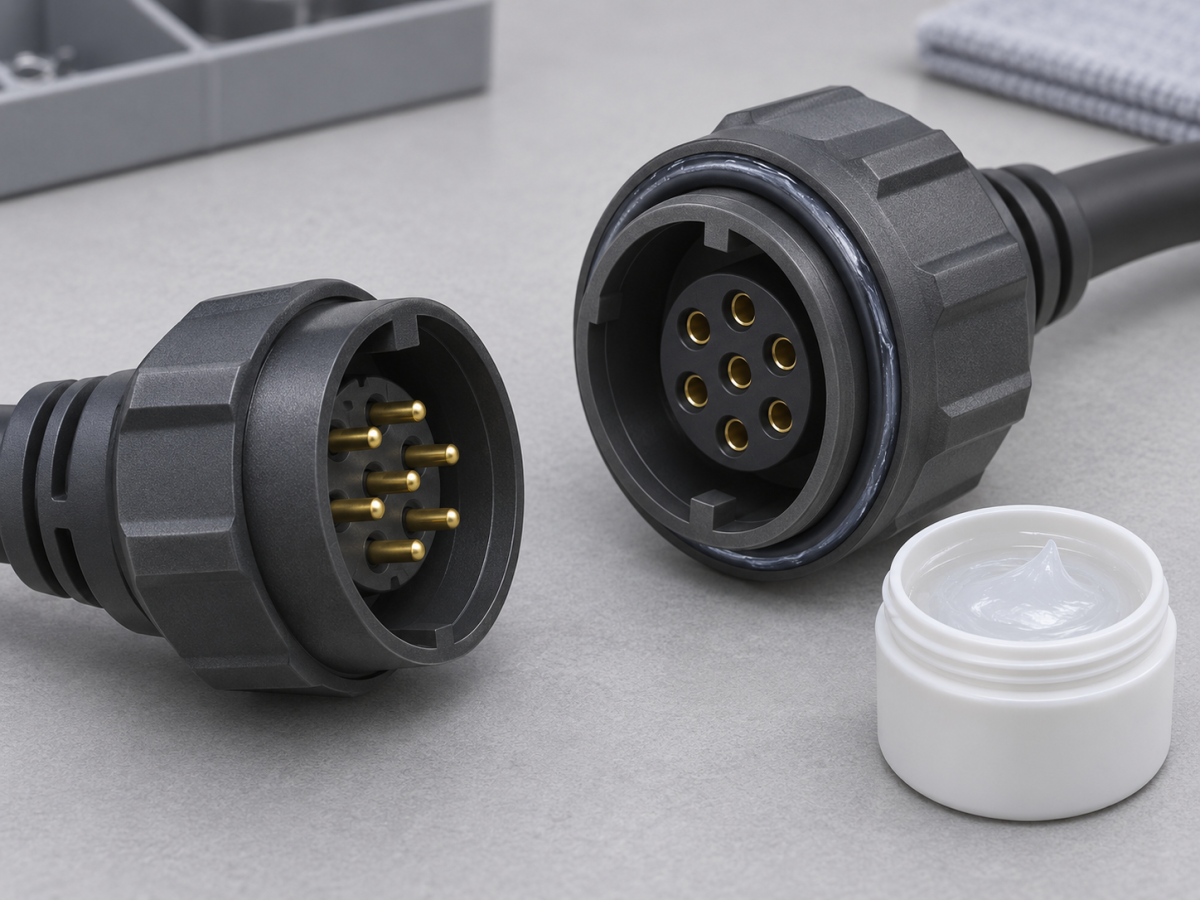
A connector seal has a simple job: keep moisture away from the connection inside. During assembly, however, a dry sealing ring can drag against the housing. A suitable silicone grease helps lubricate that ring as the parts come together and supports moisture protection around the sealed joint.
The useful distinction is between the seal around the connector and the metal contacts inside it. They do different jobs, and grease should be applied only where the connector manufacturer allows it.
Start with the perimeter seal
Consider a cable connector on an outdoor sensor. A sealing ring sits between the mating housings. As the connector closes, the ring meets the surrounding surface and forms part of the barrier against rain and damp air. Where lubrication is specified, a thin, even coating of compatible silicone grease helps the ring slide into position with less friction.
This is an application example, not a customer test result. The housing, seal and correct assembly provide the main protection. Grease supports that system; it cannot repair a cracked housing, replace a missing seal or give an ordinary connector a new waterproof rating.
Keep the contact area separate
Silicone grease is electrically insulating. It should not be treated as a way to improve electrical conductivity. Some connector designs allow a specified lubricant in the contact area, while others require that area to remain clean. Follow the connector instructions rather than spreading general-purpose grease over the pins or filling the whole cavity.
For an assembly that permits grease only on the perimeter seal, keep the application on that ring and its designated mating surface. More grease is not automatically better: excess material can be pushed into areas where it was not intended.
Match the grease to the seal material
The word “rubber” does not identify a seal well enough for grease selection. Ask for the actual material grade. Conventional silicone-oil-based grease can cause swelling or softening in silicone rubber such as VMQ or PVMQ. Fluorosilicone rubber, FVMQ, also needs assessment with the actual compound rather than an assumption of compatibility.
Temperature and exposure matter too. A connector sheltered inside an enclosure faces different conditions from one exposed to washing or prolonged immersion. Use the grease grade and application method specified for the assembly; specialist electrical applications require their own qualification.
Give your supplier the application details
When discussing silicone grease for seal assembly with Juneng, share the connector design, seal material, operating temperature and expected exposure. A drawing showing the intended grease location is especially useful.
Juneng offers formulation and packaging options for industrial supply and OEM projects. Tell us whether the grease will be dispensed on a production line or supplied in a small assembly pack, so we can discuss a suitable grade and practical packaging.
Leave A Reply