





Silicone grease is a paste-like lubricant used to help parts move smoothly, make seals easier to assemble and protect suitable joints from moisture. You may find it around an O-ring in an industrial valve, on a slow-moving plastic guide or inside the sealing area of an outdoor connector. In each case, it has a different job to do.
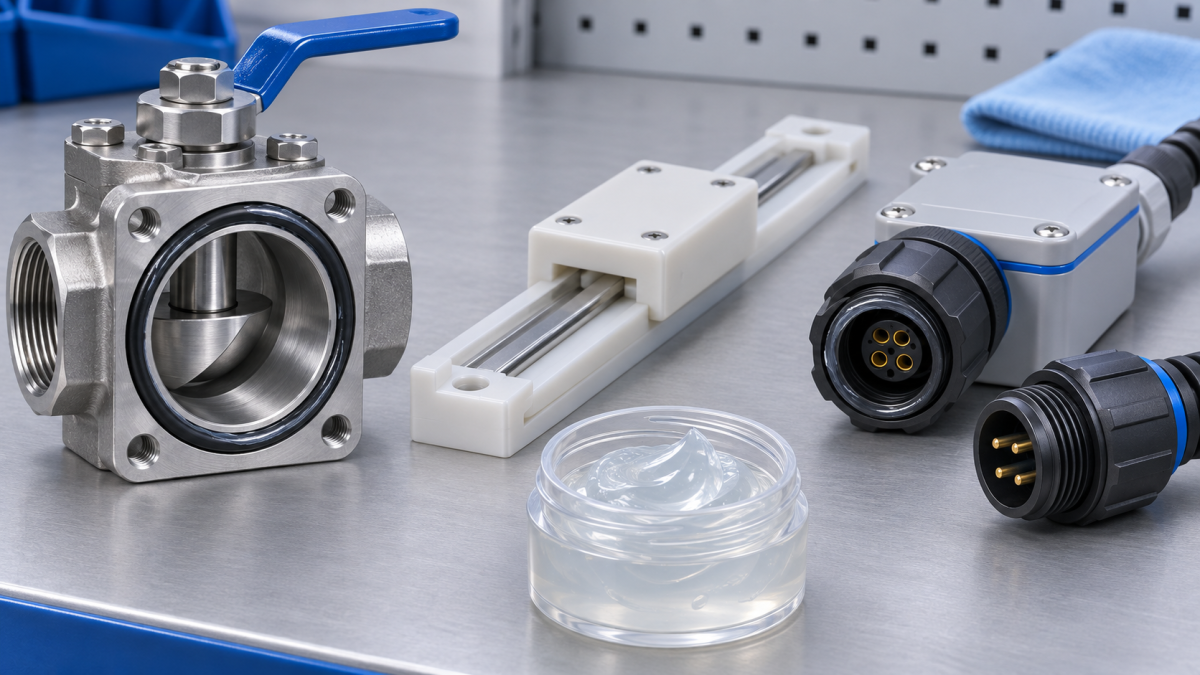
AI-generated application illustration, not a photograph of a customer installation.
Making O-Rings Easier to Install
Imagine fitting an O-ring into a valve housing. If the ring is dry, it can drag against the mating surface as the parts come together. A thin coating of suitable silicone grease helps the ring slide into position with less friction, reducing the chance of twisting or damage during assembly.
Here, the main benefit is easier assembly. The O-ring and its groove still provide the seal; grease does not repair a damaged ring or compensate for a poorly fitting joint. The same principle applies to many industrial pump seals, threaded housings and removable covers.
The grease must suit the seal material. Silicone rubber seals need particular attention because conventional silicone-oil-based grease can cause some grades to swell or soften.
Helping Plastic Slides Move More Smoothly
Consider a small plastic guide that moves back and forth when a knob is adjusted. Dry contact between the sliding surfaces can make the movement feel uneven. A suitable silicone grease provides a lubricating layer between them, helping reduce friction and making movement smoother.
This is why silicone grease is considered for low-speed, lightly loaded plastic slides, guide rails and some small plastic gears. The aim may be easier movement, less sticking or reduced friction-related noise. The plastic grade and the load determine which grease is appropriate; high-speed bearings and heavily loaded metal gears need lubricants designed for those duties.
Supporting Moisture Protection Around Connectors
An outdoor sensor connector faces a different problem: moisture can reach the cable entry and sealing joints. A suitable silicone grease can help protect the sealing area and lubricate a compatible sealing ring during assembly.
In this application, the grease supports moisture protection rather than carrying electrical current. Silicone grease is electrically insulating, so the intended location matters: the connector housing, seal and surrounding surfaces are different from the conductive contacts. Whether grease may touch those contacts depends on the connector design.
The connector's structure and seals still determine its protection against water. Adding grease alone does not give an assembly a waterproof rating.
Choosing Silicone Grease for the Job
These examples show the main roles of silicone grease: lubrication, easier assembly and support for sealing and moisture protection. The right choice starts with the part and the problem you want to solve.
Juneng supplies general-purpose silicone grease for suitable industrial applications, with formulation and packaging options to match different needs. Tell us where the grease will be used, what materials it will touch and the operating conditions. Whether you are assembling seals or improving a small plastic mechanism, that information helps us discuss a suitable grade for your application.
Leave A Reply