





Categories List
When working with electrical connections, choosing the right type of grease is essential for safety, performance, and long-term reliability. Two commonly used products—dielectric grease and conductive grease—often get confused, but they serve very different purposes. Understanding how each works will help you select the correct material for your automotive, industrial, or electronic applications.
What Is Dielectric Grease?
Dielectric grease is a silicone-based, non-conductive grease designed to protect electrical components.
Its primary properties include:
• High electrical insulation (does not conduct electricity)
• Waterproof and moisture-blocking
• High temperature resistance
• Prevents corrosion and oxidation
Because it is non-conductive, dielectric grease is used to coat and protect electrical connections rather than improve conductivity.
Common uses:
• Spark plug boots
• Automotive connectors
• Battery terminals (thin layer)
• Outdoor lighting and electrical contacts
• High-voltage silicone rubber components
Dielectric grease keeps moisture out and prevents arcing while ensuring stable long-term performance.
What Is Conductive Grease?
Conductive grease contains metallic or carbon-based fillers (such as silver, copper, or graphite), which allow it to conduct electricity.
Its main purpose is to improve electrical conductivity between surfaces.
Key characteristics:
• Electrically conductive
• Reduces contact resistance
• Improves signal or power transfer
Common uses:
• Battery buss bars
• Grounding connections
• Conductive sliding contacts
• EMI/RFI shielding applications
• Special restoration of worn connectors
Conductive grease is powerful but must be used with precision, because it can cause short circuits if misapplied.
Key Differences at a Glance
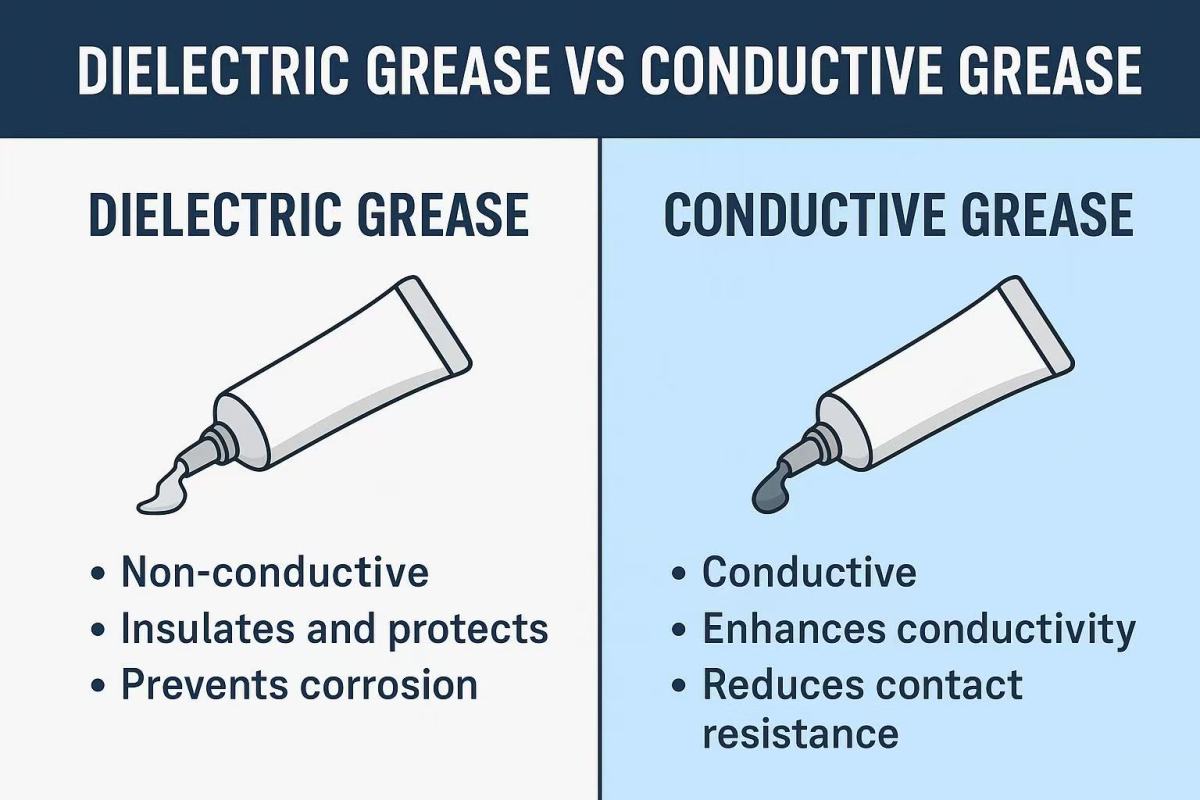
Which One Should You Choose?
Choose Dielectric Grease if you need:
✔ Moisture protection
✔ Corrosion prevention
✔ Insulation
✔ Long-term reliability
Perfect for automotive connectors, spark plugs, outdoor electrical units, and any situation where protection is more important than conductivity.
Choose Conductive Grease if you need:
✔ Better electrical path
✔ Reduced resistance
✔ Enhanced continuity
Best for battery grounding paths, metal-to-metal contacts, and specific industrial uses where current flow is essential.
Final Thoughts
Both dielectric grease and conductive grease are valuable tools in electrical maintenance—but they are not interchangeable.
Dielectric grease protects and insulates, while conductive grease enhances electrical flow.
Choosing the correct one ensures system safety, prevents failures, and extends the lifespan of your equipment.
Click the link below to learn more about the product specifications
Leave A Reply